
UNIDO–A6IP Jointly Organised Webinar on Integrating Article 13 Transparency and Article 6 Readiness
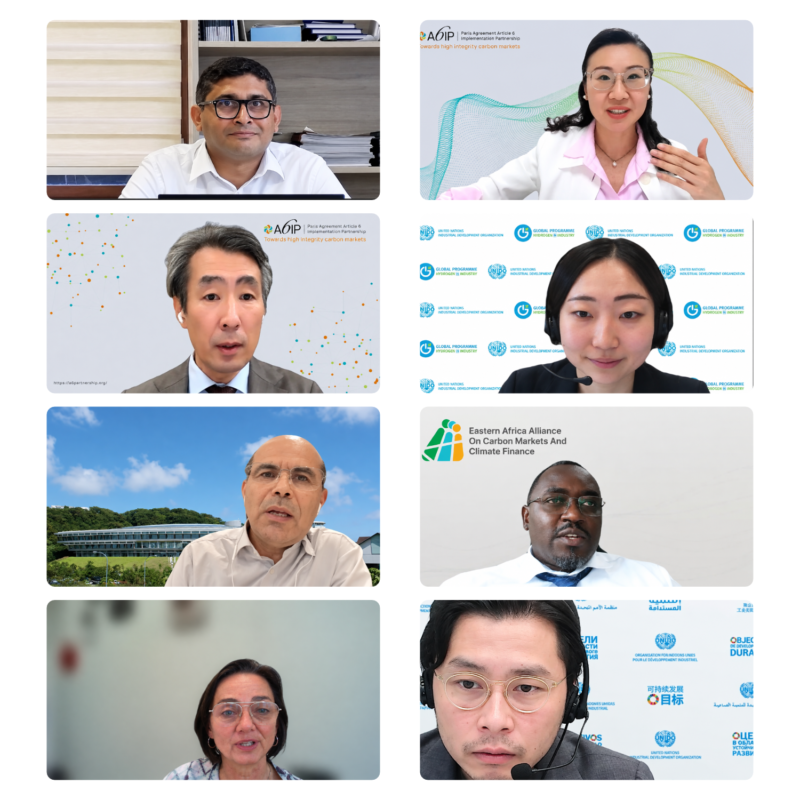
The United Nations Industrial Development Organization (UNIDO) and the Article 6 Implementation Partnership (A6IP) convened a webinar on 29 October 2026 titled “Integrating ETF (Article 13) with Article 6 Readiness”, bringing together experts and practitioners to discuss how countries can strengthen Article 6 implementation by building on existing climate transparency systems. The webinar featured technical presentations, a country case study from Sri Lanka and a panel discussion, highlighting opportunities to align institutional arrangements, improve emissions data and reporting systems, address Article 6-specific capacity gaps, and translate industrial mitigation opportunities into investment-ready projects.
Opening remarks
Petra Schwager (Chief, Climate and Technology Partnership, UNIDO) described climate transparency systems, including greenhouse gas inventories, monitoring and reporting systems, and NDC tracking, as essential foundations for understanding progress and identifying further climate action.
She emphasized that Article 13 transparency and Article 6 readiness have distinct requirements but share important capabilities, such as institutional coordination and monitoring, reporting, and verification (MRV). Coordinating the work could help countries identify capacity gaps sooner, avoid duplication, and make better use of limited resources.
For industrial decarbonisation, credible emissions data and effective institutional arrangements can help countries identify mitigation opportunities, prepare projects, and explore financing, including through carbon markets. This also requires clear procedures, capable institutions, coordinated policies, and partnerships that connect national priorities with investment opportunities.
Connecting ETF implementation and Article 6 readiness: UNIDO & A6IP perspectives
Eunji Park (Assistant Industrial Development Officer, Climate and Technology Partnership, UNIDO) explained that the ETF supports evidence-based climate policymaking, NDC tracking, identification of climate action and support needs, accountability, and the global stocktake. Article 6 interest is growing, but participation requires more than identifying mitigation opportunities: countries also need arrangements and capacity for authorization, accounting, tracking, and reporting.
She cited A6IP report findings presented in the webinar: 94 parties reported that authorization or tracking systems were established, underway, or planned, while 91% of NDC 3.0 submissions indicated an intention to use or consider using Article 6. She stressed that existing transparency systems, such as inventories, sectoral data, NDC tracking, and MRV capacity, can provide a foundation for Article 6 readiness, but do not replace Article 6-specific requirements, including corresponding adjustments where applicable.
Park outlined two UNIDO initiatives and potential sectoral work:
- Global Carbon Market Accelerator Programme (GC-MAP): Intends to bridge national institutional readiness and practical industrial mitigation opportunities. It aims to coordinate country-level capacity building, build on existing initiatives such as the GEF-funded Capacity-building Initiative for Transparency and GCF readiness support, identify remaining capacity needs, and connect readiness to project development.
- Carbon Market for Development (CM4D) partnership: A platform for collaboration in which UNIDO can act as a neutral convener. Potential partners include technology and knowledge providers, investors, project developers, carbon-credit buyers, industry associations, and civil society.
She identified areas in UNIDO’s portfolio that could provide starting points for assessing mitigation opportunities: ozone-depleting substance and HFC management, cement, small hydropower, biochar, nature-based solutions, circular economy, waste management, green bricking, and SME development. Each opportunity would need further assessment of mitigation potential, monitoring requirements, technical and financial feasibility, and alignment with national priorities and relevant carbon-market frameworks.
Park concluded with the key message that transparency, Article 6 readiness, and industrial mitigation should be treated as complementary parts of implementing national climate priorities.
Dr. Rabhi Abdessalem (Senior Program Manager, A6IP) described three Article 6.2 reporting components:
- Initial report: Covers participation requirements and other information related to the NDC. It should be submitted as soon as possible and no later than the authorization of ITMOs, and is made publicly available through the relevant UNFCCC reporting platform.
- Annual information: Quantitative ITMO information, including authorization, transfer, use, and cancellation. The presentation noted an annual submission deadline of 15 April and reporting in electronic format.
- Regular information: Quantitative and qualitative information on Article 6.2 implementation, submitted every two years and included as an annex to the Biennial Transparency Report (BTR). The presentation referred to a 31 December deadline.
Abdessalem emphasized that corresponding adjustments are needed to avoid double counting and that countries need tracking arrangements, such as registries, to follow ITMOs. He described the ETF and Article 6 as linked through NDC progress and reporting.
Additional findings from the A6IP status report were presented: the survey covered nearly 160 participants; 94 reported authorization or tracking arrangements as prerequisites established or underwya. However, only around 15 had these arrangements actually in place. Twenty-three countries had submitted initial reports. He also cited 81 Article 6-related programmes and noted that comparatively little support was focused on reporting and transparency, despite their direct connection to the ETF.
Country example: Linking industrial emissions data with investment opportunities in Sri Lanka
Jagathdeva Vidanagama (Chief Technical Specialist, Energy Systems and Industrial Decarbonization, UNIDO) presented a EU-funded project supporting Sri Lanka’s industrial-sector MRV system and NDC implementation. The work covers the energy and industrial processes and product use (IPPU) sectors.
The project’s analysis found that industry consumes about one-third of national electricity across approximately 68,000 industries. Consumption is concentrated: the top 350 industries account for 43% of industrial electricity use, and the top 6,000 account for 92%. The project therefore prioritised energy-intensive industries, where energy-efficiency improvements could have greater impact.
The project also produced subsectoral electricity data for manufacturing, including information on subsectors such as food and beverage, tea, and textiles and apparel.
The system comprises three pillars:
- Institutional arrangements
- Procedures and protocols
- An IT platform
The project mapped energy and IPPU data sources, data providers, sector leads, data estimation, interagency coordination, quality assurance, expert support, and policy coordination. It also established data-sharing arrangements.
A key approach is to make data flows regular – ideally on an annual basis, rather than only every two or three years. The project is using the annual Environmental Protection Licence (EPL) process to collect climate-related data. The presentation said that approximately 56,000 industries should obtain EPLs annually, and that this route could cover more than 98% of industrial-sector energy consumption and emissions. The work also supports mitigation reporting through the National Green Reporting System, data harmonisation among government institutions, and five-digit industry classification.
The project yielded the following outcomes:
- Revising industrial-sector MRV arrangements and improving the flow of data into the system.
- Supporting ministries in revising the NDC, including the addition of HFCs and an increased target, and developing an NDC implementation plan.
- Policy work, including recommendations for the top 100 energy-intensive industries, sector diagnostics, a textile decarbonisation roadmap, a net-zero roadmap, and a roadmap for electrifying industrial heat.
- Industry capacity-building in energy management and system optimisation, implementation of no- and low-cost measures, and preparation of bankable proposals for capital-intensive measures.
- Demonstrations of 10 capital-intensive low-carbon technologies, including industrial-heat electrification, and support for energy-auditor training.
In conclusion, governments are recommended to consider implementing similar initiatives with the broad aim of strengthening the existing system, improving industrial performance, and creating enabling conditions for carbon markets and other climate action.
Panel discussion
Linking systems and clarifying gaps
In response to a question about practical integration, Abdessalem said that coordinating ETF and Article 6 work can support consistent NDC accounting and market integrity, reduce double counting and inconsistent reporting, and avoid duplicated structures and requests.
He recommended building on existing institutions and data. For example, connecting Article 6 authorities with inventory teams, BTR coordinators, and sector ministries, with clear responsibilities and shared procedures. He also encouraged coordinated capacity-building rather than separate, unconnected training programmes.
Regional and institutional perspective
Andrew Ocama (coordinator of the East African Alliance on Carbon Markets and Climate Finance) said that the ETF can provide the framework connecting Article 6 activity with reporting and accountability. He identified legal mandates and institutional arrangements as a starting point: they establish authority, clarify roles, and support resource planning.
He described countries in the region as being at different stages of readiness. He highlighted the need for published authorization criteria linked to NDCs, standard procedures and guidelines, and accounting infrastructure to support corresponding adjustments and tracking, including registry functions. He also recommended tailoring capacity-building to countries’ needs rather than relying on a single template.
Turning data into project pipelines
Naoki Torii (Industrial Development Officer, Climate and Technology Partnership, UNIDO) said that reliable industrial data on energy use, production processes, and emissions can help countries identify where mitigation opportunities exist. Combining this information with technology assessments and sector analysis can help determine which technologies are suitable, which enterprises could implement them, and what barriers they face.
Carbon-market finance might help address investment barriers, including for more capital-intensive measures. Torii stressed that countries should use existing transparency systems as a foundation while identifying additional information and capacity needs. Governments can then make informed choices about which activities to prioritise, taking into account NDC implications, corresponding adjustments, and development benefits.
UNIDO’s role can include industrial expertise, country engagement, convening, technical cooperation, technology assessment, engagement with enterprises and partners, and examination of whether carbon revenues could help address project financing gaps.
Audience question: an example of Article 13 and Article 6 integration
Asked for a country example, Ocama named Rwanda as a country that had taken significant steps and described the work as ongoing. Torii noted that transactions and BTR submissions were developing, and that a clear, established linkage between Article 13 and Article 6 was not yet necessarily evident. He framed this integration as an area requiring further support.
The discussion also stressed that countries can work on transparency improvements and Article 6 institutional arrangements in parallel, rather than waiting for one system to be fully complete before starting the other. Sectoral transparency data may also help identify emitters and potential project partners, while projects still need to meet applicable Article 6 eligibility requirements and secure the necessary finance.
Closing remarks
Kazuhisa Koakutsu (Director, A6IP Center) expressed his appreciation to the co-organisers, organising team, speakers and panellists. He also shared three key takeaways from the webinar:
- Build on what already exists. Article 13 has a more established foundation, with its rules agreed in 2018 and the first Biennial Transparency Reports (BTRs) submitted in 2024. The second BTR cycle is now underway in 2026. By contrast, the Article 6 rulebook was agreed in Glasgow in 2021 and finalised in Baku in 2024. Integration between Articles 13 and 6 is still at an early stage, but will become increasingly important in the years ahead.
- Clarify and address Article 6-specific gaps. While corresponding adjustments are reported through BTRs and Article 6 reporting, Article 6 introduces additional requirements and capacity gaps, particularly in reporting, review and registry arrangements. Targeted support and capacity building are therefore essential to enable effective integration of Article 6 and Article 13 reporting. These capacity gaps were also highlighted by Andrew from the Eastern African Alliance.
- Turn readiness into investment. A robust framework integrating Articles 6 and 13 can strengthen confidence and help mobilise private-sector investment. Ultimately, the purpose of Article 6 and carbon markets is to accelerate and realise new and additional mitigation activities, as highlighted by Jagath and Naoki from UNIDO.
He concluded by welcoming UNIDO's CM4D initiative and calling for continued collaboration on capacity building and private-sector engagement.
Conclusion
This webinar has highlighted the importance of aligning Article 13 transparency arrangements with Article 6 readiness to build on existing institutional capacities, data systems and processes, while addressing additional requirements for Article 6 implementation. Strengthening institutional coordination, clarifying roles and responsibilities, and enhancing MRV, accounting and reporting systems will be critical to ensuring the integrity of countries’ participation in carbon markets and identifying further mitigation opportunities.
Looking forward, A6IP and UNIDO will continue strengthening collaboration among governments, development partners, technical institutions and the private sector to translate readiness efforts into effective implementation, mobilise investment and deliver measurable mitigation outcomes.
For more details, visit: UNIDO - A6IP Joint Webinar… | Article 6 Implementation Partnership